CO2 mineralization
Carbon mineralization refers to the inorganic reaction that transforms gaseous CO2 into solid carbonates. The transformation is considered permanent since the decomposition of carbonates cannot occur without considerable energy input, and because carbonates are thermodynamically stable. Besides, carbonates are environmentally benign (NPC, 2019c). A typical carbonation reaction consists in reacting a metal oxide (MO) with CO2:

In nature, this chemical reaction rarely occurs due to the elevated temperatures required.
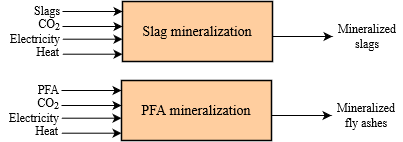
In TIAM-FR, either steel slags or pulverized fly ashes can be mineralized along with electricity and heat to operate the mineralization process, as shown in Figure 1. The cost o mineralizing steel slags is comprised between  100/tCO2 (NASEM, 2019). However, the amount of CO2 mineralized per ton of mineral produced is 0.02-0.07 tCO2/t, 0.37-0.64 tCO2/t, and 0.31-0.45 tCO2/t respectively for coal fly ahs, steel slags, and blast furnace slags (Meng et al., 2021). The energy requirements to process mineralization are estimate to 400 kWh of electricity and 354 kWh of heat per ton of CO2 sequestered (Huijgen, 2006).
Fig. 2: Commodity flows in and out mineralization processes
References
NASEM, 2019. Negative Emissions Technologies and Reliable Sequestration: A Research Agenda. National Academies Press, Washington, D.C. https://doi.org/10.17226/25259
Meng, J., Way, R., Verdolini, E., Diaz Anadon, L., 2021. Comparing expert elicitation and model-based probabilistic technology cost forecasts for the energy transition. Proceedings of the National Academy of Sciences 118, e1917165118. https://doi.org/10.1073/pnas.1917165118
Huijgen, W.J.J., Ruijg, G.J., Comans, R.N.J., Witkamp, G.-J., 2006. Energy Consumption and Net CO2 Sequestration of Aqueous Mineral Carbonation. Ind. Eng. Chem. Res. 45, 9184–9194. https://doi.org/10.1021/ie060636k