Synthetic fuels
The technological options for synthetic fuels in TIAM-FR encompasses 3 routes:
hydrogenation of CO2 into methanol
methanaton of CO2 into methane
Fischer-Tropsch process into a range of synthetic fuels
For routes converting CO2 into synthetic fuels, several designs are implemented depending on the nature of the CO2 processed and the type of hydrogen, i.e. either generated by dedicated variable renewable assets or centralized electricity. Concerning the nature of CO2, we distinguish fossil and process CO2 from biogenic and atmospheric CO2. As hydrogen is not involved in the mineralization of CO2, only the nature of CO2 processed in differentiated.
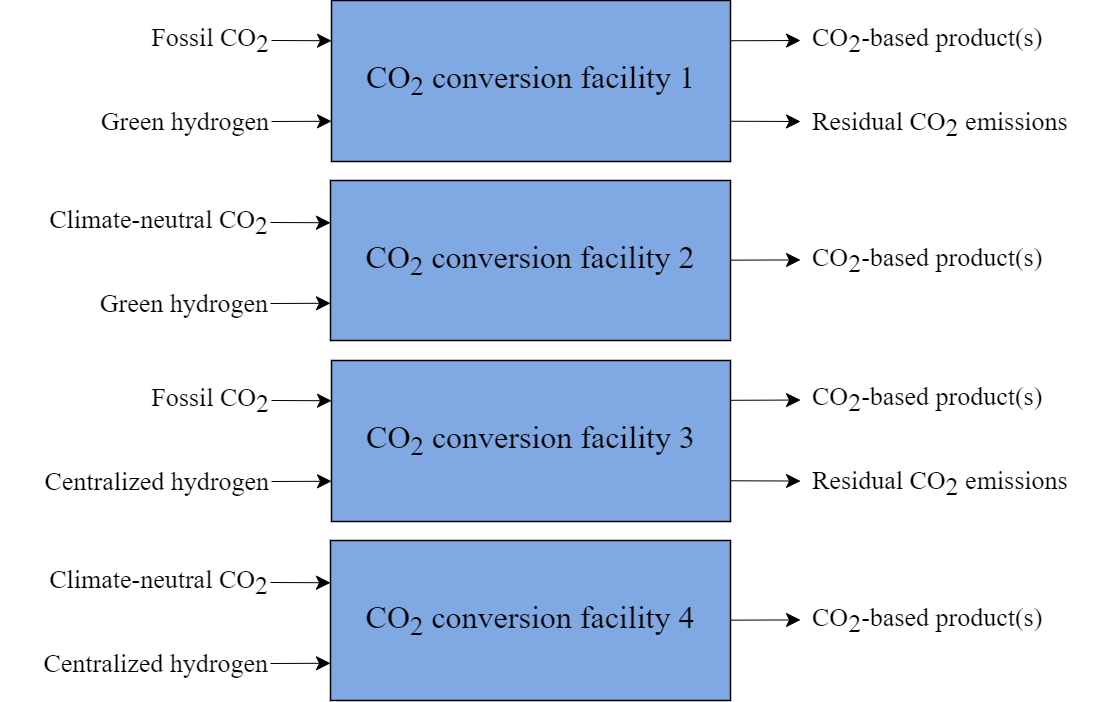 Fig. 1: Different designs for CO2 utiliation in TIAM-FR
As it is assumed that 90% of the CO2 processed is actually converted, and residual emissions are accounted for 1% of the CO2 flow in the case where fossil CO2 is employed. For processes convertin CO2 into synthetic fuels, capacity designs are assumed to a commercial capacity of 11.2 PJ/y (Winchester et al., 2013). All CO2 utilization processes are commercially available as of 2030.
Hydrogenation
Methanol (CH₃OH or MeOH) is an alcohol used as a fuel for transportation demands such as buses, heavy trucks, light trucks, and cars. The main process to generate methanol is to make CO2 react with H2, also yielding water as a by-product:

The techno-economic assumptions for this processes are taken from Zhang et al. (2019) and summarized in Table 1.
Tab. 1: Techno-economic properties of the hydrogenation process in TIAM-FR
Properties |
Units |
Values |
|---|---|---|
Hydrogen efficiency |
J/J |
1.08 |
CO2 efficiency |
g/J |
75.4 |
CAPEX |
$/GJpa |
20 |
Fixed O&M |
$/GJpa |
0.7 |
Availability factor |
90% |
|
Life |
years |
20 |
Discount rate |
8% |
The techno-economic assumptions for CO2 capture can be found in sections related to the power sector, biofuels, industry, and direct air capture. The techno-economic assumptions for hydrogen supply can be found here.
Besides, methanol turned into gasoline through the so-called Methanol-to-Gasoline (MtG) process for which liquified petroleum gas (LPG) and electricity are co-products. Likewise, the MtG process can employ fossil-based or climate-neutral methanol. The techno-economic assumptions for this process are extrated from Hennig and Haase (2021) and summarized in Table 2:
Tab. 2: Techno-economic properties of Methanol-to-Gasoline in TIAM-FR (Henning and Haase, 2021)
Properties |
Units |
Values |
|---|---|---|
Gasoline yield |
J/J |
0.52 |
LPG yield |
J/J |
0.40 |
Electricity generation |
J/J |
0.1 |
CAPEX |
$/GW |
5 |
Fixed O&M |
$/GW |
0.04 |
Availability factor |
90% |
|
Life |
years |
15 |
Discount rate |
7% |
In TIAM-FR, methanol is only modeled as an energy carrier, not as a chemical good. The energy demand for methanol as a chemical is implicitly modeled and included in the overall energy demand of the chemical industry.
Methanation
Methanation is a process turning CO2 and H2 into synthetic CH4 through the following reaction:

The synthetic methane can be utilized in end-use processes to substitute for natural gas. The techno-economic properties of methanation processes implemented in TIAM-FR are taken from Chauvy et al. (2021) and summarized in Table 3.
Tab. 3: Techno-economic properties of methanation processes in TIAM-FR (Chauvy et al., 2021)
Properties |
Units |
Values |
|---|---|---|
CO2 input |
kg/GJ |
50.5 |
Hydrogen input |
J/J |
1.2 |
Electricity consumption |
J/J |
0.002 |
Excess heat |
J/J |
0.18 |
CAPEX |
$/GW |
86.5 |
Fixed O&M |
$/GW |
6.5 |
Availability factor |
90% |
|
Life |
years |
20 |
Discount rate |
8% |
Fischer-Tropsch
The Fischer-Tropsch reaction consists in processing CO2 with hydrogen in the presence of a catalyst at temperatures between 150-200°C to generate a slate of liquid hydrocarbons, generally diesel, gasoline, and kerosene. The generation shares depend on the catalyst employed. In TIAM-FR, the Fischer-Tropsch processes implemented follow the assumptions of Zang et al. (2021), as Table 4 summarizes.
Tab. 3: Techno-economic properties of Fischer-Tropsch processes in TIAM-FR (Zang et al., 2021)
Properties |
Units |
Values |
|---|---|---|
CO2 input |
kg/GJ |
50.5 |
Hydrogen input |
J/J |
1.2 |
Electricity consumption |
J/J |
0.002 |
Excess heat |
J/J |
0.18 |
CAPEX |
$/GW |
86.5 |
Fixed O&M |
$/GW |
6.5 |
Availability factor |
90% |
|
Life |
years |
20 |
Discount rate |
8% |
The synthetic liquids supply all sectors of the economy, just like conventional fossil fuels, thus assuming for instance that synthetic kerosene is a perfect subsitute for conventional jet fuels, which is yet to be proven technically.
References
Zhang, H., Wang, L., Van herle, J., Maréchal, F. & Desideri, U. Techno-Economic Optimization of CO2-to-Methanol with Solid-Oxide Electrolyzer. Energies 12, 3742 (2019).
Hennig, M. & Haase, M. Techno-economic analysis of hydrogen enhanced methanol to gasoline process from biomass-derived synthesis gas. Fuel Processing Technology 216, 106776 (2021).
Chauvy, R., Verdonck, D., Dubois, L., Thomas, D. & De Weireld, G. Techno-economic feasibility and sustainability of an integrated carbon capture and conversion process to synthetic natural gas. Journal of CO2 Utilization 47, 101488 (2021).
Zang, G., Sun, P., Elgowainy, A. A., Bafana, A. & Wang, M. Performance and cost analysis of liquid fuel production from H2 and CO2 based on the Fischer-Tropsch process. Journal of CO2 Utilization 46, 101459 (2021).